


RAG Arena & Dynamic Routing

RAG Arena &
Dynamic Routing
Compare multiple knowledge bases side-by-side, discover which performs best for each question type, and let the system automatically route future queries to the winning source.
Side-by-Side Knowledge Comparison
Send a question to multiple RAG configurations simultaneously. See how different knowledge bases respond, then pick the winner.
 Qdrant
 Monitoring during the first 8 weeks: serum creatinine + eGFR, hepatic enzymes (ALT/AST), and blood pressure — at baseline, week 4, week 8, then quarterly thereafter.
Dose adjustments: No adjustment for mild renal impairment (eGFR > 60). Moderate-to-severe (eGFR 30–59) requires a 50% reduction. Severe hepatic impairment (Child-Pugh C): not recommended.
Interactions: Strong CYP3A4 inhibitors are contraindicated. With moderate inhibitors, limit to 20 mg/day.
Sources: clinical-guidelines-2024.pdf p.142–146 · pharmacology-handbook.pdf p.78
 Cloudflare Vectorize
 Common side effects: nausea, headache, and mild dizziness — typically transient and resolve within the first month. Severe reactions are rare (<0.1%) but include hepatotoxicity; discontinue immediately if jaundice or unexplained transaminase elevation occurs.
Discontinuation: Taper gradually over 1–2 weeks to avoid withdrawal symptoms. The drug is metabolized primarily by CYP2D6; poor metabolizers may require lower doses or alternative agents.
Sources: prescribing-info-v3.pdf p.12 · safety-monitoring.pdf p.34–37
How RAG Arena Works
A structured process for finding the best knowledge base configuration for every question type.
Configure Variants
Set up 2-8 arena variants, each pointing to a different RAG vector or knowledge base.
Run in Parallel
Send questions to all variants simultaneously. Each retrieves context from its own knowledge base.
Compare & Score
View responses side-by-side with inline quality scores for relevance, hallucination, and completeness.
Learn & Route
The system learns which knowledge base wins for each question type and routes future queries automatically.
Dynamic RAG Routing
Once arena results establish preferences, incoming questions are automatically routed to the best-performing knowledge base — no manual configuration needed.
Built for Enterprise RAG
Everything you need to optimize retrieval quality at scale.
Multi-Provider Support
Compare across Qdrant, Cloudflare Vectorize, Couchbase, MongoDB Atlas, and more in a single arena experiment.
Inline Quality Scoring
Every response is scored for relevance, hallucination, correctness, and completeness in real time.
Auto-Fix Integration
Arena results feed into the QA auto-fix loop, automatically learning optimal routing with quality thresholds.
Full Audit Trail
Every routing decision is tracked with source (arena, auto-fix, or manual), scores, and timestamps in MongoDB.
Fast Routing via KV
Learned preferences stored in Cloudflare KV for sub-millisecond lookups. MongoDB maintains the full history.
Arena Presets
Save, name, and reuse arena configurations. Export as portable JSON for sharing across teams.
Supported Vector Providers
Run arena experiments across any combination of vector databases.
QdrantCloudflare Vectorize Couchbase
 Vertex AI Vector Search
 PageIndex
RAG Retrieval Architectures
Route queries to different retrieval strategies based on question type. Each architecture optimizes for different use cases.
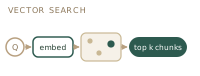
Vector Search
Semantic similarity matching via dense embeddings. Best for natural language questions and conceptual lookups.
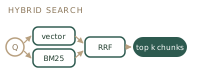
Hybrid (BM25 + Vector)
Combines keyword matching with semantic search using Reciprocal Rank Fusion. Best for precise technical queries.
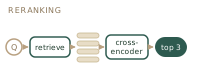
Reranking
Initial retrieval followed by cross-encoder reranking for precision. Best for high-stakes answers requiring accuracy.
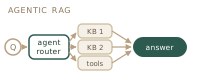
Agentic RAG
LLM-driven routing across multiple knowledge bases and tools. Best for complex multi-step questions requiring synthesis.
Find your optimal RAG configuration
Stop guessing which knowledge base performs best. Let RAG Arena show you the data, then let Dynamic Routing handle the rest.