


LLM Safety and Quality Assurance - Evaluate Before Release

LLM Quality Assurance
Enterprise testing and validation for AI applications. Automated hallucination detection, bias monitoring, and continuous quality scoring.
What is LLM Quality Assurance?
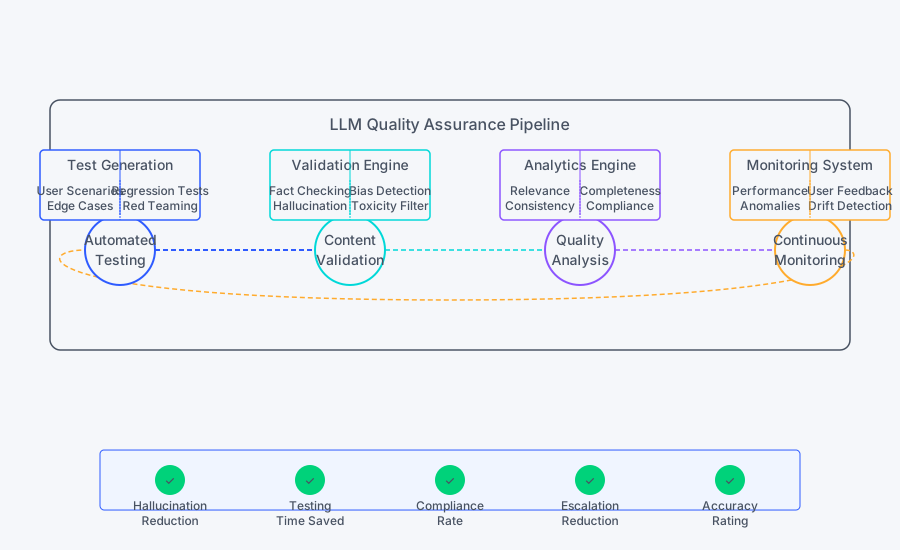
Divinci AI's Quality Assurance platform ensures enterprise-grade reliability and safety for your LLM applications. Our comprehensive testing and validation pipeline catches issues before they reach production, maintaining the highest standards of accuracy and compliance.
Traditional quality assurance approaches fall short with AI systems due to their non-deterministic nature and the complexity of evaluating generated content. Our platform addresses these unique challenges with automated testing frameworks, content validation engines, and continuous monitoring systems specifically designed for LLM applications.
With comprehensive test generation, real-time validation, and intelligent monitoring, our platform ensures your AI applications deliver consistent, accurate, and safe responses while maintaining regulatory compliance and building user trust.
Key Benefits
Quality Assurance
Comprehensive testing and validation pipeline that ensures enterprise-grade reliability and safety for your LLM applications with automated quality control.
Automated Testing
Generate comprehensive test scenarios automatically including edge cases, regression tests, and red teaming for thorough validation.
Content Validation
Advanced validation engine with fact checking, bias detection, and toxicity filtering to maintain content quality and safety standards.
Continuous Monitoring
Real-time performance monitoring, anomaly detection, and drift detection to maintain optimal AI performance over time.
Enterprise Compliance
Maintain regulatory compliance with comprehensive audit trails, data governance, and industry-specific validation requirements.
Self-Improving Analytics
Continuously learns and optimizes quality assessment patterns based on validation results and user feedback.
How Quality Assurance Works
Automated Test Generation
Generate comprehensive test scenarios including user scenarios, edge cases, regression tests, and red teaming to ensure reliability
Content Validation
Advanced validation with fact checking, hallucination detection, bias detection, and toxicity filtering
Quality Analytics
Evaluate relevance, consistency, completeness, and compliance to ensure enterprise requirements
Continuous Monitoring
Real-time monitoring with performance analytics, anomaly detection, and user feedback collection
Quality Assurance Pipeline
End-to-End LLM Quality Validation
Automated Testing
Generate comprehensive test scenarios including user scenarios, edge cases, regression tests, and red teaming to validate LLM reliability.
Content Validation
Advanced validation engine performs fact checking, hallucination detection, bias detection, and toxicity filtering for content quality.
Quality Analysis
Analytics engine evaluates relevance, consistency, completeness, and compliance to ensure enterprise-grade requirements.
Continuous Monitoring
Real-time performance monitoring, anomaly detection, user feedback collection, and drift detection for ongoing optimization.
Inside the Scoring Engine — How Calibration Actually Works
Most "AI testing" tools score model outputs and stop there. Divinci's scored-QA suite is built around a different premise: your scoring rubric needs to be calibrated against a domain expert before its scores can be trusted. Here's how that pipeline ships today.
Human-anchored rubric calibration
A domain expert rates the same rubric the LLM judge uses on a stratified gold set — every score (0 / 0.25 / 0.5 / 0.75 / 1.0) is captured with optional reasoning and an optional editedResponse field that doubles as supervised-fine-tuning signal. Each rating logs the rater identity, the rubric version, and the wall-clock duration. Spearman ρ between the LLM judge and the expert rater is computed continuously; the judge with the highest ρ becomes the default.
- Multi-rater agreement: when more than one expert rates the same item, inter-rater ρ is computed so we can detect rater disagreement as well as judge-vs-human disagreement.
- Per-suite calibration target: each scored-QA suite carries a
rhoLowerTarget+rhoTargetN— the floor the calibration must clear and the sample size it must clear it on before the judge is trusted. - Active learning: the pre-rating pipeline preferentially surfaces high-variance items (where the LLM judges disagree most) for expert review, so a small expert budget calibrates the noisy decision boundary first.
Auto-fix loop with explicit autonomy levels
Once a suite is calibrated, the auto-fix loop iterates: it scores the candidate, applies a small reformulation or retrieval-config change, re-scores, and repeats until one of four terminal states. The autonomy level decides whether human approval is required between iterations.
full-auto— runs to convergence without human gates.checkpoint-every-iteration— human approves each candidate change.checkpoint-on-deploy— runs unattended but pauses for human sign-off before promoting to production.- Terminal states:
high-scores,target-reached,max-iterations, orrunning. Modes:autofixfor prompt/retrieval tuning,autoragfor retrieval-pipeline reconfiguration.
RAG Arena — variant comparison at suite scale
A single API call fans the suite out across multiple RAG configurations — different retrieval backends (the ten RAG Routing targets), different LLMs, different prompt templates — and scores every (variant × test) pair with the calibrated judge. The result is a per-variant ranking, a per-test best-variant winner, and a markdown report.
The arena is also the upstream source for our learned routing model: when a customer picks an arena winner, the (question, winning-backend) pair seeds the routing-history store.
Endpoint: POST /api/v1/qa/suites/:suiteId/arena-run with { arenaPresetId, testIds?, maxTestsPerVariant? }.
Audit-grade scoring receipts
Every score in the system is logged with the information you need to defend it months later. Each test result carries a per-scorer score map — one 0–1 score per scorer plus an aggregated overall score. Each calibration rating is stored with the rater's identity, a content-hash of the rubric prompt used, the rating itself, optional reasoning, the wall-clock duration, and (if supplied) the edited response.
- Rubric versioning: we content-hash the rubric prompt with SHA-256 and use a 16-character prefix as the version ID — any rubric edit produces a new version automatically; old scores stay attached to the old rubric.
- Threshold gates: per-suite
minScorefloor +maxDriftregression thresholds fire webhooks / email on breach, with the configured monitoring cadence (hourly / daily / weekly / manual). - Editable rater feedback: rater-supplied
editedResponseis preserved as a downstream SFT signal — calibration is also free training data.
The eight LLM-judge scorers we ship
Every scored-QA test runs through this set by default. Each scorer is an independent LLM call against a parametric rubric prompt; rubric edits produce new rubricVersion hashes so historical scores remain meaningful. Customers can disable any scorer per-suite or supply their own.
Plus first-class integrations with the open-source and commercial frameworks our customers already use:
How the scoring engine connects to the rest of the platform
The calibrated judges power our RAG Arena for variant comparison and feed the RAG Routing learned-history store that picks the best backend per query. The full deep-dive on judge calibration is the blog post Calibrating the Judge: The Grader Gets Graded; the arena and routing story together is at Inside the RAG Arena: When the Judges Don't Agree. For how this fits into a full release pipeline, see the regression-testing post and the CI testing post.
Frequently Asked Questions
AI quality assurance addresses unique challenges that traditional testing approaches can't handle. While traditional software testing focuses on deterministic outcomes, AI systems generate variable responses that require content-aware validation, bias detection, and contextual accuracy assessment.
Our platform evaluates not just functional correctness but also content quality, safety, compliance, and ethical considerations that are critical for enterprise AI deployments.
Our comprehensive validation engine performs multiple types of quality checks:
- Fact Checking: Validates factual accuracy against reliable knowledge sources
- Hallucination Detection: Identifies when AI generates false or unsupported information
- Bias Detection: Scans for unfair bias in AI responses across protected categories
- Toxicity Filtering: Prevents harmful, offensive, or inappropriate content
- Compliance Validation: Ensures responses meet industry-specific regulatory requirements
- Consistency Checking: Validates that similar queries receive consistent responses
Our continuous monitoring system tracks AI performance in real-time through multiple channels:
- Performance Analytics: Monitor response accuracy, latency, and user satisfaction metrics
- Anomaly Detection: Automatically identify unusual patterns that may indicate model degradation
- Drift Detection: Track changes in model behavior over time and alert on significant shifts
- User Feedback Integration: Collect and analyze user feedback to identify quality issues
- Automated Alerting: Instant notifications when quality thresholds are breached
The system maintains detailed audit logs and provides dashboards for real-time visibility into AI system health and performance trends.
Ready to transform AI quality?
Ensure enterprise-grade reliability and safety for your LLM applications with automated testing and validation.