


LLM Quality Assurance
LLM Quality Assurance
De volledige versie van deze pagina staat hieronder in het Engels.

LLM Quality Assurance
Enterprise testing and validation for AI applications. Automated hallucination detection, bias monitoring, and continuous quality scoring.
What is LLM Quality Assurance?
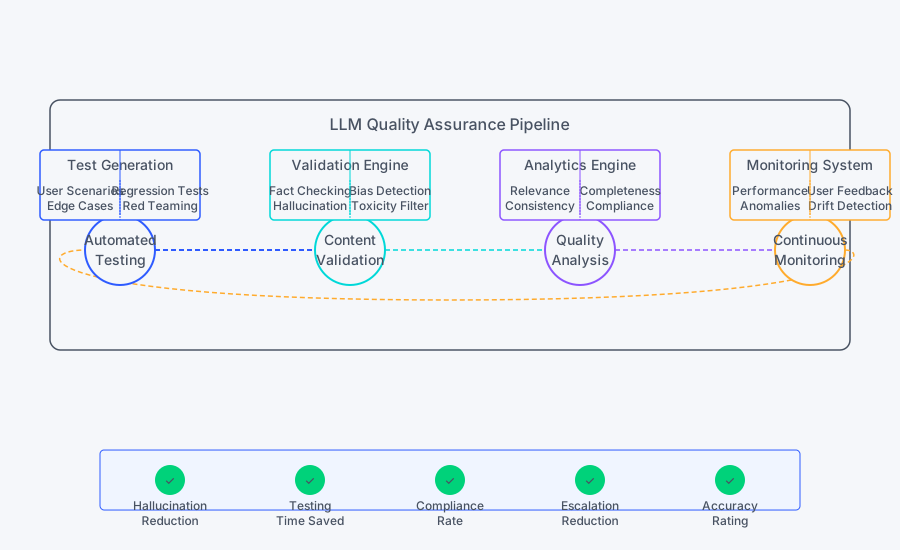
Divinci AI's Quality Assurance platform ensures enterprise-grade reliability and safety for your LLM applications. Our comprehensive testing and validation pipeline catches issues before they reach production, maintaining the highest standards of accuracy and compliance.
Traditional quality assurance approaches fall short with AI systems due to their non-deterministic nature and the complexity of evaluating generated content. Our platform addresses these unique challenges with automated testing frameworks, content validation engines, and continuous monitoring systems specifically designed for LLM applications.
With comprehensive test generation, real-time validation, and intelligent monitoring, our platform ensures your AI applications deliver consistent, accurate, and safe responses while maintaining regulatory compliance and building user trust.
Key Benefits
Quality Assurance
Comprehensive testing and validation pipeline that ensures enterprise-grade reliability and safety for your LLM applications with automated quality control.
Automated Testing
Generate comprehensive test scenarios automatically including edge cases, regression tests, and red teaming for thorough validation.
Content Validation
Advanced validation engine with fact checking, bias detection, and toxicity filtering to maintain content quality and safety standards.
Continuous Monitoring
Real-time performance monitoring, anomaly detection, and drift detection to maintain optimal AI performance over time.
Enterprise Compliance
Maintain regulatory compliance with comprehensive audit trails, data governance, and industry-specific validation requirements.
Self-Improving Analytics
Continuously learns and optimizes quality assessment patterns based on validation results and user feedback.
How Quality Assurance Works
Automated Test Generation
Generate comprehensive test scenarios including user scenarios, edge cases, regression tests, and red teaming to ensure reliability
Content Validation
Advanced validation with fact checking, hallucination detection, bias detection, and toxicity filtering
Quality Analytics
Evaluate relevance, consistency, completeness, and compliance to ensure enterprise requirements
Continuous Monitoring
Real-time monitoring with performance analytics, anomaly detection, and user feedback collection
Quality Assurance Pipeline
End-to-End LLM Quality Validation
Automated Testing
Generate comprehensive test scenarios including user scenarios, edge cases, regression tests, and red teaming to validate LLM reliability.
Content Validation
Advanced validation engine performs fact checking, hallucination detection, bias detection, and toxicity filtering for content quality.
Quality Analysis
Analytics engine evaluates relevance, consistency, completeness, and compliance to ensure enterprise-grade requirements.
Continuous Monitoring
Real-time performance monitoring, anomaly detection, user feedback collection, and drift detection for ongoing optimization.
In de scoring-engine — hoe kalibratie echt werkt
De meeste "AI-testtools" beoordelen modeloutputs en stoppen daar. De scored-QA-suite van Divinci is gebouwd op een ander uitgangspunt: je scoring-rubric moet worden gekalibreerd tegen een domeinexpert voordat de scores te vertrouwen zijn. Zo werkt die pijplijn vandaag in productie.
Rubric-kalibratie verankerd in menselijk oordeel
Een domeinexpert beoordeelt dezelfde rubric die de LLM-judge gebruikt op een gestratificeerde gold-set — elke score (0 / 0.25 / 0.5 / 0.75 / 1.0) wordt vastgelegd met optionele redenering en een optioneel editedResponse-veld dat tegelijk dient als supervised-fine-tuning-signaal. Bij elke beoordeling worden de identiteit van de beoordelaar, de rubric-versie en de doorlooptijd gelogd. De Spearman ρ tussen de LLM-judge en de menselijke beoordelaar wordt continu berekend; de judge met de hoogste ρ wordt de standaard.
- Overeenstemming tussen meerdere beoordelaars: wanneer meer dan één expert hetzelfde item beoordeelt, wordt de inter-rater ρ berekend zodat we onenigheid tussen beoordelaars én tussen judge en mens kunnen detecteren.
- Kalibratiedoel per suite: elke scored-QA-suite draagt een
rhoLowerTarget+rhoTargetN— de ondergrens die de kalibratie moet halen en de steekproefomvang waarop dat moet gebeuren voordat de judge wordt vertrouwd. - Active learning: de pre-rating-pijplijn brengt bij voorkeur items met hoge variantie (waar de LLM-judges het meest van mening verschillen) naar de expert voor review, zodat een klein expertbudget eerst de ruisachtige beslissingsgrens kalibreert.
Auto-fix-lus met expliciete autonomieniveaus
Zodra een suite is gekalibreerd, itereert de auto-fix-lus: hij scoort de kandidaat, past een kleine herformulering of retrieval-config-wijziging toe, scoort opnieuw en herhaalt dit tot één van vier terminale toestanden. Het autonomieniveau bepaalt of menselijke goedkeuring vereist is tussen iteraties.
full-auto— draait tot convergentie zonder menselijke poortwachters.checkpoint-every-iteration— een mens keurt elke kandidaatwijziging goed.checkpoint-on-deploy— draait onbemand maar pauzeert voor menselijke goedkeuring vóór promotie naar productie.- Terminale toestanden:
high-scores,target-reached,max-iterationsofrunning. Modi:autofixvoor prompt-/retrieval-tuning,autoragvoor herconfiguratie van de retrieval-pijplijn.
RAG Arena — varianten vergelijken op suite-schaal
Eén API-aanroep waaiert de suite uit over meerdere RAG-configuraties — verschillende retrieval-backends (de tien RAG Routing-doelen), verschillende LLM's, verschillende prompt-templates — en scoort elk (variant × test)-paar met de gekalibreerde judge. Het resultaat is een ranking per variant, een winnaar-per-test en een markdown-rapport.
De arena is ook de bovenstroomse bron voor ons geleerde routing-model: wanneer een klant een arena-winnaar kiest, vormt het (vraag, winnende-backend)-paar zaad voor de routing-history-store.
Endpoint: POST /api/v1/qa/suites/:suiteId/arena-run met { arenaPresetId, testIds?, maxTestsPerVariant? }.
Audit-waardige scoring-bewijsstukken
Elke score in het systeem wordt vastgelegd met de informatie die je nodig hebt om hem maanden later te kunnen verdedigen. Elk testresultaat draagt een score-map per scorer — één 0–1 score per scorer plus een geaggregeerde overall-score. Elke kalibratiebeoordeling wordt opgeslagen met de identiteit van de beoordelaar, een content-hash van de gebruikte rubric-prompt, de beoordeling zelf, optionele redenering, de doorlooptijd en (indien aangeleverd) de bewerkte response.
- Rubric-versionering: we hashen de rubric-prompt met SHA-256 en gebruiken een 16-tekens prefix als versie-ID — elke rubric-bewerking levert automatisch een nieuwe versie op; oude scores blijven gekoppeld aan de oude rubric.
- Drempelpoorten: per-suite
minScore-ondergrens +maxDrift-regressiedrempels triggeren webhooks / e-mail bij overschrijding, met de geconfigureerde monitoring-cadans (uur / dag / week / handmatig). - Bewerkbare feedback van beoordelaars: door beoordelaars geleverde
editedResponsewordt bewaard als downstream SFT-signaal — kalibratie is ook gratis trainingsdata.
De acht LLM-judge-scorers die we leveren
Elke scored-QA-test loopt standaard door deze set. Elke scorer is een onafhankelijke LLM-aanroep tegen een parametrische rubric-prompt; rubric-bewerkingen produceren nieuwe rubricVersion-hashes, zodat historische scores betekenisvol blijven. Klanten kunnen elke scorer per suite uitschakelen of een eigen scorer leveren.
Plus eersteklas integraties met de open-source en commerciële frameworks die onze klanten al gebruiken:
Hoe de scoring-engine aansluit op de rest van het platform
De gekalibreerde judges voeden onze RAG Arena voor variantvergelijking en leveren input aan de RAG Routing learned-history-store die per vraag de beste backend kiest. De volledige deep-dive over judge-kalibratie staat in de blogpost Calibrating the Judge: The Grader Gets Graded; het gecombineerde verhaal over de arena en routing vind je in Inside the RAG Arena: When the Judges Don't Agree. Voor hoe dit past in een volledige release-pijplijn, zie de post over regressie-testing en de post over CI-testing.
Success Stories
Global Healthcare Provider
95% reduction in AI hallucinations while processing 50,000+ medical queries daily
A leading healthcare provider needed to ensure medical AI responses met the highest safety standards. Using our Quality Assurance platform, they implemented comprehensive testing and validation, achieving unprecedented accuracy for patient-facing AI systems while maintaining regulatory compliance.
"Divinci AI's Quality Assurance platform gave us the confidence to deploy AI in critical healthcare scenarios. The comprehensive testing and real-time validation ensure our patients receive accurate, safe information every time."
— Dr. Maria Rodriguez, Chief Medical Officer, Healthcare Leader
Financial Services Firm
Achieved 99.9% compliance rate for regulatory queries with automated bias detection and fact-checking across 25,000+ daily customer interactions.
Request Details →Legal Technology Platform
Reduced manual review time by 85% while maintaining 99.5% accuracy for legal document analysis across 100+ law firms.
Request Details →Educational Institution
Ensured content safety and accuracy for 500,000+ student interactions with comprehensive toxicity filtering and educational content validation.
Request Details →Frequently Asked Questions
AI quality assurance addresses unique challenges that traditional testing approaches can't handle. While traditional software testing focuses on deterministic outcomes, AI systems generate variable responses that require content-aware validation, bias detection, and contextual accuracy assessment.
Our platform evaluates not just functional correctness but also content quality, safety, compliance, and ethical considerations that are critical for enterprise AI deployments.
Our comprehensive validation engine performs multiple types of quality checks:
- Fact Checking: Validates factual accuracy against reliable knowledge sources
- Hallucination Detection: Identifies when AI generates false or unsupported information
- Bias Detection: Scans for unfair bias in AI responses across protected categories
- Toxicity Filtering: Prevents harmful, offensive, or inappropriate content
- Compliance Validation: Ensures responses meet industry-specific regulatory requirements
- Consistency Checking: Validates that similar queries receive consistent responses
Our continuous monitoring system tracks AI performance in real-time through multiple channels:
- Performance Analytics: Monitor response accuracy, latency, and user satisfaction metrics
- Anomaly Detection: Automatically identify unusual patterns that may indicate model degradation
- Drift Detection: Track changes in model behavior over time and alert on significant shifts
- User Feedback Integration: Collect and analyze user feedback to identify quality issues
- Automated Alerting: Instant notifications when quality thresholds are breached
The system maintains detailed audit logs and provides dashboards for real-time visibility into AI system health and performance trends.
Ready to transform AI quality?
Ensure enterprise-grade reliability and safety for your LLM applications with automated testing and validation.