




As artificial intelligence becomes increasingly integrated into critical business processes and decision-making systems, the importance of building responsible AI cannot be overstated. Organizations deploying AI systems are facing growing scrutiny from regulators, customers, and stakeholders who expect these systems to be fair, transparent, and accountable.
Why Responsible AI Matters
The deployment of AI systems without proper ethical considerations can lead to:
- Discriminatory outcomes that perpetuate or amplify existing biases
- Loss of trust from customers and stakeholders
- Regulatory compliance issues as AI governance frameworks evolve
- Reputational damage from publicized AI failures
- Legal liability for harmful or biased decisions
Conversely, organizations that prioritize responsible AI development often see improved customer trust, better regulatory relationships, and more robust, reliable AI systems.
Core Principles of Responsible AI
Fairness and Non-discrimination
AI systems should treat all individuals and groups equitably, avoiding discrimination based on protected characteristics. This requires:
- Bias auditing throughout the development lifecycle
- Diverse dataset representation
- Fairness metrics evaluation across demographic groups[1]
- Ongoing monitoring for discriminatory outcomes
Organizations like Google, Microsoft, and IBM have published comprehensive frameworks for evaluating algorithmic fairness, emphasizing that different contexts may require different fairness definitions (demographic parity, equalized odds, or individual fairness).[2]
Transparency and Explainability
Users and stakeholders should be able to understand how AI systems make decisions, especially for high-stakes applications:
- Model interpretability techniques (SHAP, LIME, attention visualization)[4]
- Decision pathway documentation
- Clear communication about AI system capabilities and limitations
- Audit trails for critical decisions
Privacy and Security
AI systems must protect user data and maintain security throughout the data lifecycle:
- Data minimization principles aligned with GDPR and privacy regulations[5]
- Encryption and secure storage
- Access controls and authentication
- Privacy-preserving techniques like differential privacy and federated learning[6]
Safety and Reliability
AI systems should perform reliably and safely across diverse conditions:
- Robust testing across edge cases
- Graceful degradation when encountering unexpected inputs
- Human oversight mechanisms
- Continuous monitoring and alerting
Human Agency and Oversight
Humans should maintain meaningful control over AI systems:
- Human-in-the-loop workflows for critical decisions
- Override mechanisms for AI recommendations
- Clear escalation paths when AI confidence is low
- Regular human review of AI system performance
Implementing Responsible AI Across the Development Lifecycle

Planning and Design
Stakeholder Engagement: Involve diverse stakeholders early in the design process, including domain experts, affected communities, and ethics specialists.
Risk Assessment: Conduct thorough impact assessments to identify potential risks and harms from AI system deployment.
Design Requirements: Establish clear requirements for fairness, transparency, and safety that will guide development decisions.
Data Collection and Preparation
Bias Auditing: Systematically evaluate datasets for representation gaps and historical biases. Research from MIT and Stanford has demonstrated that unrepresentative training data is one of the primary sources of algorithmic bias.[3]
Data Quality: Implement comprehensive data validation and quality assurance processes.
Documentation: Maintain detailed data lineage and provenance records.
Model Development and Testing
Diverse Evaluation Metrics: Go beyond accuracy to evaluate fairness, robustness, and explainability.
Stress Testing: Test models against adversarial examples and edge cases.
Cross-Group Validation: Ensure model performance is consistent across demographic groups.
Deployment and Monitoring
Phased Rollout: Deploy AI systems gradually with careful monitoring at each stage.
Continuous Monitoring: Implement real-time monitoring for model drift, bias, and performance degradation.
Feedback Loops: Establish mechanisms for collecting and incorporating user feedback.
How Application Class Reshapes the Risk Surface
The same responsible-AI principles instantiate very differently across application classes. Retrieval-augmented generation systems concentrate risk in the knowledge base composition and attribution path — bias in the corpus surfaces as biased grounding, and ungrounded generation is indistinguishable from grounded generation without explicit citation. Conversational systems concentrate risk in the conversation boundary — what the system will and will not engage with, and how it escalates when its confidence is misplaced. Document-processing systems concentrate risk in the confidence-vs-action gap — a 92%-accurate extractor used to populate a downstream database produces 8% systematic error at scale, which is qualitatively different from a 92%-accurate classifier whose outputs a human reviews.
These differences matter for governance design. A single “AI fairness checklist” applied uniformly across all three classes will over-engineer the lowest-risk surface and under-engineer the highest-risk one. Risk-class-specific evaluation — different fairness metrics, different escalation thresholds, different audit cadence per application class — is the more useful framing.
Responsible AI Governance
Effective governance structures are essential for maintaining responsible AI practices:
AI Ethics Board: Establish cross-functional oversight with diverse expertise.
Policy Framework: Develop clear policies and procedures for AI development and deployment.
Training Programs: Ensure all team members understand responsible AI principles.
Regular Audits: Conduct periodic reviews of AI systems and practices.
Incident Response: Establish clear procedures for addressing AI-related issues.
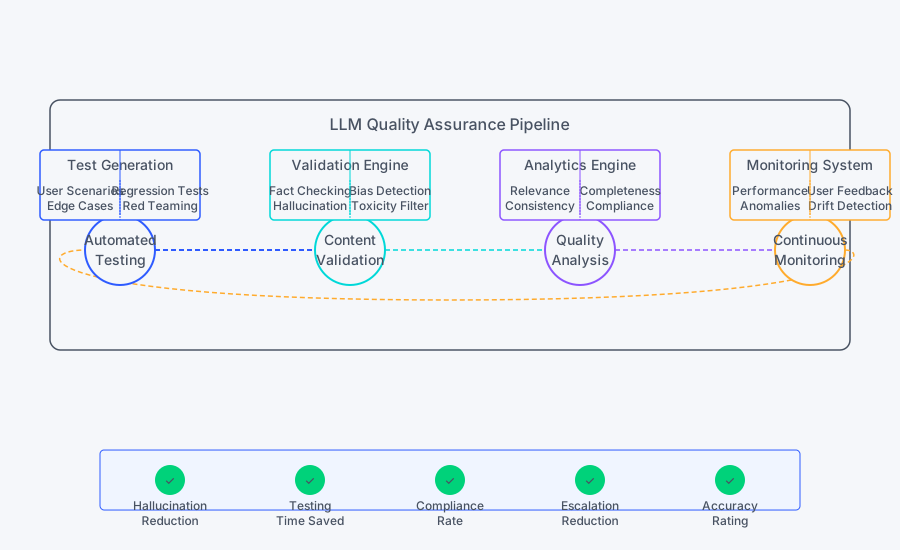 Implementing explainability and monitoring throughout the AI pipeline
Balancing Innovation with Responsibility
One common concern is that responsible AI practices might slow innovation or limit system capabilities. However, our experience shows that:
- Early integration of responsible AI practices reduces later remediation costs
- Transparent systems often perform better due to improved understanding and trust
- Diverse perspectives in development lead to more robust and innovative solutions
- Proactive compliance provides competitive advantages as regulations evolve
Conclusion: The Path Forward
Building responsible AI systems requires intentional effort and ongoing commitment, but the benefits—increased trust, better outcomes, and reduced risk—far outweigh the costs. Key recommendations for organizations starting this journey:
- Start Early: Integrate responsible AI practices from project inception
- Invest in Education: Ensure teams understand both technical and ethical considerations
- Establish Governance: Create clear oversight and accountability structures
- Measure Progress: Develop metrics for tracking responsible AI implementation
- Stay Informed: Keep up with evolving best practices and regulatory requirements
The work is ultimately operational rather than aspirational. Responsible AI is what you measure, what you document, what triggers escalation, and what gets reviewed — not what you state in a press release. The organizations that get this right are the ones that build the measurement surface before they need it, and treat the responsible-AI scaffolding as a first-class deliverable alongside the model itself.
References
Ready to Build Your Custom AI Solution?
Discover how Divinci AI can help you implement RAG systems, automate quality assurance, and streamline your AI development process.
Get Started Today